Action Images: raw pose → multi-view pixel-grounded actions
arXiv 2604.06168 run on FreeTacMan motherboard_0510_episode_001,
frames 719–1019 (10 s, sustained motion), three calibrated RealSense views
(left / middle / right) at 640×480.
Instead of feeding a policy a low-dimensional action vector, each action is converted into
points that live in the same 2D pixel space as the observation, in every camera view.
The raw 7-DoF pose from the parquet
Each frame carries an absolute pose per tactile sensor:
[x, y, z] in metres (OptiTrack mocap frame) and an
xyzw quaternion. This is the "raw robot action" to be converted.

Pose becomes q_pos, q_normal, q_up (ℓ = 100 mm)
Following the paper: q_pos is the end-effector point,
q_normal = q_pos + ℓ·(surface normal), q_up = q_pos +
ℓ·(orthogonal in-plane axis). One deliberate departure: this rig is calibrated, so the
normal is the measured gel axis (T_gel_to_rigid) and q_pos the real
gel centre, rather than the paper's canonical gripper axes.

Trajectory of q_pos (red, = the position channel) with normal (green) and up (blue) triads drawn every second, in mocap millimetres.
Project into each calibrated camera view
Chain: pose (m) → ×1000 → gel centre in mocap mm → T_mocap_to_cam →
pinhole intrinsics → pixels. Calibration rmse is 4.7 / 5.3 / 7.5 mm for
left / middle / right. Over the whole episode 97–100% of points land in-frame with
positive depth; the demo segment is 100% visible in all three views.
Filled dot = projected gel centre (blue = left sensor, orange = right), thick arrow → normal point, thin arrow → up point, label = depth. The dot staying on the physical sensor in all three views is the calibration check.
Render as RGB Gaussian heatmaps (the paper's format)
Each projected triple becomes an H×W×3 image: R = position,
G = normal, B = up,
σ = 0.05·min(H, W). Stacked over time (6 fps grid) this is the action video the
paper pairs with the observation video per view. Two departures, documented in
build_action_images.py: one image per sensor (two sensors would be
indistinguishable in one RGB image), and no gripper-openness term (handheld rig).
Rows = views. Columns: observation · left-sensor action image · right-sensor action image · blend. In the blend, the Gaussian triads must sit on the sensors — and they do. Yellow = R+G overlap where the normal point projects near the position point.
Raw action video, middle view, left sensor.
Raw action video, middle view, right sensor.
Validation against AllTracker optical flow
The representation claims to explicitly track robot motion in image space. Two checks against AllTracker on the real videos:
A. Drift-free local-motion check (the decisive one). At every frame (30 fps) the dense adjacent flow (t → t+1) is sampled at the projected gel-centre pixel and compared with the projected point's own displacement. No long-range tracking is involved, so nothing can drift:
| view / sensor | median EPE (px/frame) | p95 | median EPE, moving | cosine (moving) | gain |
|---|---|---|---|---|---|
| left / left | 0.77 | 2.65 | 0.90 | 0.910 | 0.94 |
| left / right | 0.20 | 0.90 | 0.44 | 0.948 | 0.97 |
| middle / left | 0.85 | 2.99 | 0.97 | 0.912 | 0.97 |
| middle / right | 0.24 | 1.27 | 0.57 | 0.854 | 1.02 |
| right / left | 0.76 | 4.31 | 0.92 | 0.868 | 0.69 |
| right / right | 0.19 | 1.74 | 0.52 | 0.824 | 1.06 |

Per-frame displacement of the projected point vs AllTracker flow under it (u and v pooled). Points hug the dashed y=x line in every view: the projected action moves the way the pixels under it move.
B. Long-range reference tracks. AllTracker reference mode (query = segment start) tracking the physical gel-centre pixel:
Filled dot + colored trail = pose-projected; white ring + trail = AllTracker.
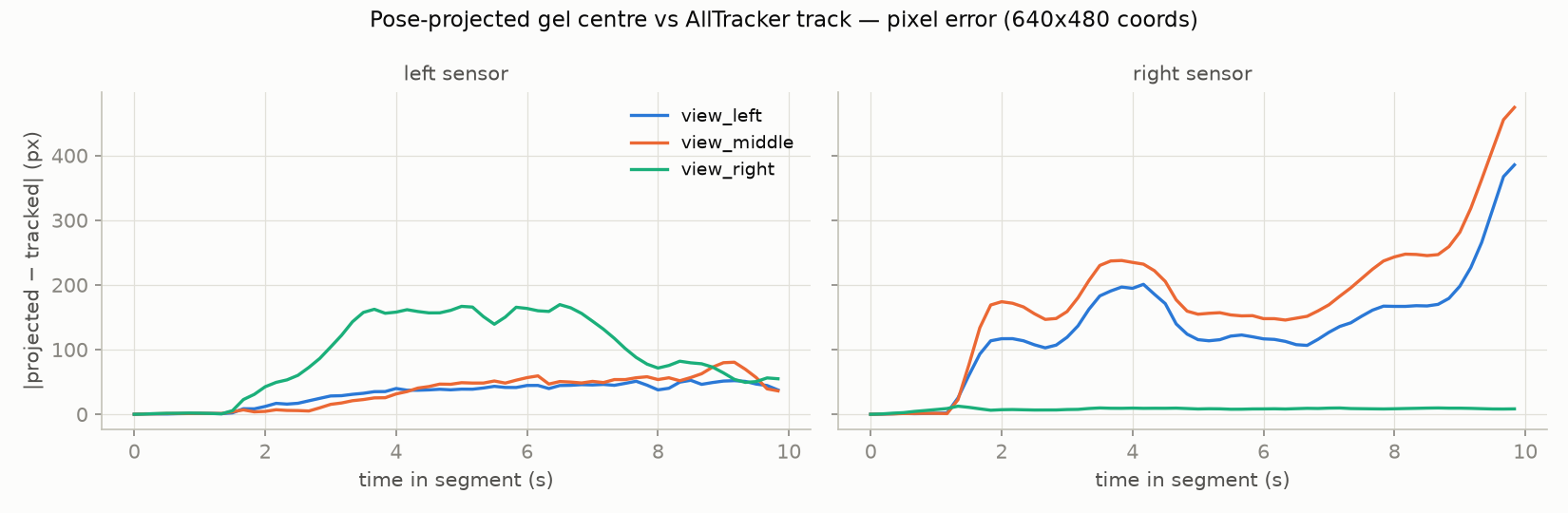
Where the tracker stays locked (view_right / right sensor: flat ~8 px for 10 s — about the 7.5 mm calibration rmse at 0.9 m depth) the two tracks agree throughout. The large reference-track errors elsewhere onset abruptly when a sensor starts moving and never recover — the signature of tracker drift under strong rotation and occlusion, not projection error. The drift-free check in A isolates the projection itself, and it passes in all six view×sensor combinations.
Scripts
world_model/data_preprocessing/project_pose_to_camera.py (geometry) ·
render_pose_overlay.py (step 2) · build_action_images.py (step 3) ·
action_images_demo/alltracker_validate.py + step4_metrics.json
(step 4). Demo artifacts live in
mode1_v2_videos/motherboard_0510_episode_001/action_images_demo/.